


TOKYO –
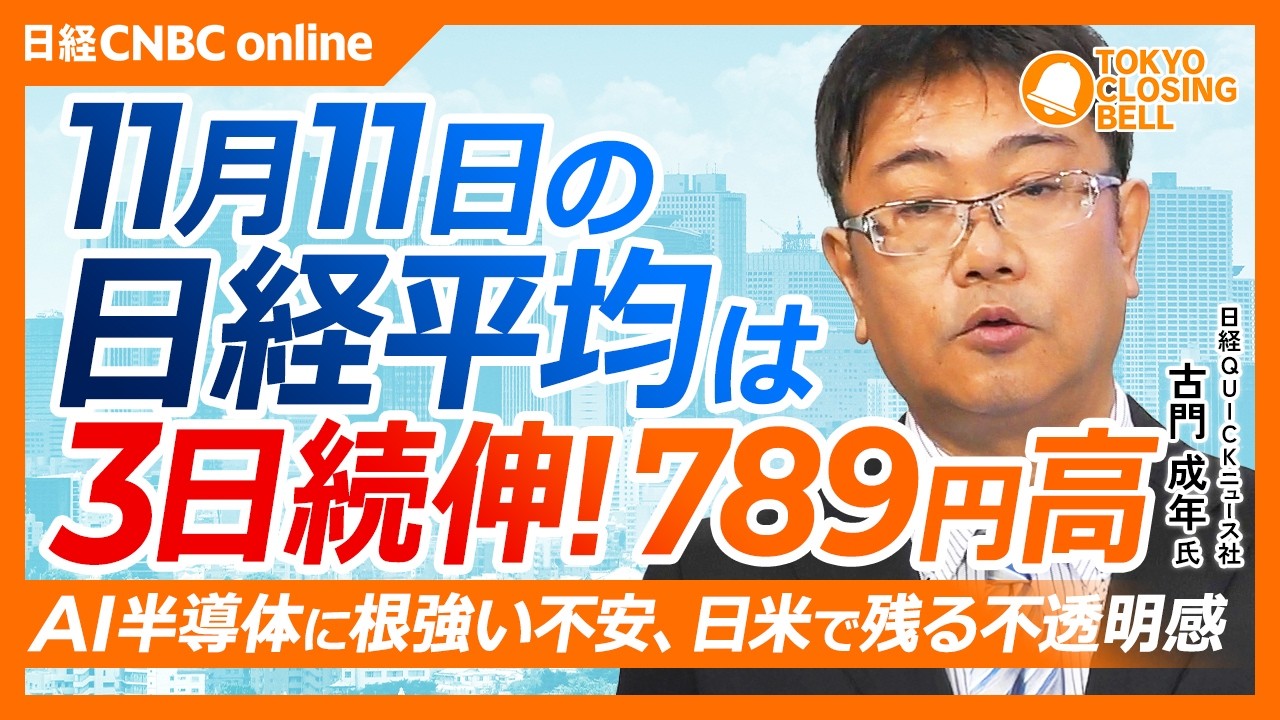
Tokyo shares prolonged their restoration on Wednesday, November eleventh, with the Nikkei 225 closing at 61,248.59 factors as of three:30 p.m., up 789.01 factors, or 1.31%, from Tuesday, marking a 3rd consecutive session of features as buyers purchased semiconductor and synthetic intelligence-related shares regardless of renewed considerations over US inflation and rates of interest.
The advance adopted a 1,684-point surge on Tuesday, when the benchmark regained the psychologically vital 60,000-point degree after a pointy selloff late final week. Wednesday’s features introduced the Nikkei’s three-day restoration to greater than 3,800 factors, though the index remained beneath its November fifth closing degree of 61,077.90 solely till it moved above that mark through the session.
Semiconductor-related shares had been the principal drivers of Wednesday’s rally, with Advantest contributing roughly 378 factors to the Nikkei’s advance, adopted by Tokyo Electron at about 135 factors and Ibiden at almost 68 factors. TDK and reminiscence chip producer Kioxia additionally offered vital assist, reflecting continued investor confidence in demand for superior computing tools and parts utilized in synthetic intelligence methods.
The shopping for got here regardless of weak point on Wall Street in a single day, the place stronger-than-expected US shopper inflation figures raised considerations that the Federal Reserve might keep restrictive financial coverage or contemplate additional rate of interest will increase. The Dow Jones Industrial Average fell 157.86 factors to 52,231.89 on Tuesday, whereas the Nasdaq Composite declined 187.26 factors to 25,065.88.
Trading in Tokyo started cautiously, with the Nikkei opening simply 65.72 factors greater at 60,525.30. The index briefly got here beneath promoting strain earlier than semiconductor shares attracted renewed shopping for, lifting the benchmark above 61,000 through the morning session. Gains accelerated after the noon break, with the index reaching an intraday excessive of 61,366.25.
The restoration was not restricted to know-how shares. Of the Tokyo Stock Exchange’s 33 trade teams, 20 completed greater, led by textiles, electrical tools, banking and nonferrous metals. Rubber merchandise, land transportation and airways had been among the many weaker sectors, demonstrating that buyers remained selective regardless of the broader enchancment in market sentiment.
Among particular person corporations, Fast Retailing, the operator of Uniqlo, was the most important unfavorable contributor to the Nikkei, lowering the index by roughly 88 factors. Konami Group, Recruit Holdings, Honda Motor and telecommunications firm KDDI additionally weighed on the benchmark.
Market breadth was reasonably optimistic on the Tokyo Stock Exchange’s Prime Market, the place 834 shares superior, 666 declined and 45 remained unchanged.
The broader Topix index additionally superior, closing at 3,929.39 factors, up 35.68 factors, or 0.92%, from Tuesday. Its efficiency indicated that the restoration was spreading past the semiconductor corporations which have dominated market actions in latest months.
In forex buying and selling, the yen weakened towards the US dollar, buying and selling round 158.80 to 158.90 yen throughout Wednesday’s afternoon session, in contrast with roughly 158.04 yen at Tuesday’s Tokyo market shut. The dollar’s energy mirrored rising US Treasury yields following the unexpectedly sturdy inflation figures, whereas the weaker yen offered extra assist for Japanese exporters by enhancing the worth of abroad earnings when transformed into Japanese forex.
Attention additionally turned to Japan’s newest company confidence figures, which confirmed that producers had been turning into more and more optimistic about enterprise circumstances. The Reuters Tankan survey launched Wednesday discovered that sentiment amongst main Japanese producers rose to plus 27 in November from plus 22 in October, reaching its highest degree since August 2021.
Confidence amongst electronics producers climbed notably sharply, rising to plus 39 from plus 25, supported by sturdy demand for semiconductors, together with reminiscence chips utilized in synthetic intelligence purposes. Sentiment amongst precision equipment producers additionally improved, whereas chemical substances, oil refining and ceramics corporations reported extra favorable enterprise circumstances.
The outlook for Japan’s companies sector strengthened even additional, with the nonmanufacturing sentiment index leaping to plus 35 from plus 23, its highest studying since June 2018. Information and communications corporations benefited from sturdy orders, whereas companies companies reported sustained demand for employees. However, corporations continued to establish rising prices, greater rates of interest and difficulties passing bills on to clients as vital challenges.
Corporate earnings remained one other vital focus following SoftBank Group’s announcement on Tuesday of a internet lack of roughly 1.1 trillion yen for the July-September quarter, reversing a revenue of about 2.5 trillion yen a yr earlier. The outcomes highlighted the monetary pressures related to the know-how funding firm’s aggressive enlargement into synthetic intelligence infrastructure, together with information facilities and its substantial funding in OpenAI.
SoftBank’s quarterly financing prices greater than doubled from a yr earlier to 462 billion yen, whereas modifications to deliberate US information middle initiatives resulted in a multibillion-dollar cost. The figures intensified scrutiny of the corporate’s borrowing and funding technique at a time when international buyers have gotten extra cautious concerning the tempo of returns from synthetic intelligence spending.
In the automotive sector, Nissan Motor reported its newest earnings after Wednesday’s stock market shut, asserting a internet lack of 39.7 billion yen for the April-September interval, considerably narrower than the 221.9 billion yen loss recorded a yr earlier. Revenue elevated 8.8% to roughly 6.07 trillion yen, whereas working revenue improved to 80 billion yen from an working lack of 27.7 billion yen.
The enchancment mirrored value reductions and restructuring measures beneath Chief Executive Ivan Espinosa, though Nissan’s July-September working revenue plunged to simply 2.1 billion yen from 51.5 billion yen a yr earlier, demonstrating the difficulties dealing with the automaker’s turnaround.
Nissan maintained its full-year working revenue forecast of 200 billion yen however diminished its international automobile gross sales outlook to between 2.97 million and three million items, in contrast with its earlier estimate of three.15 million. The firm cited more and more tough circumstances in China, the place competitors from electrical automobile producers continues to accentuate, whereas gross sales in Japan and the United States have proven larger resilience.
The newest outcomes underline the contrasting forces shaping Japan’s company sector, with know-how corporations benefiting from increasing funding in synthetic intelligence whereas conventional producers face mounting aggressive pressures and rising working prices.
For buyers, the quick query is whether or not the Nikkei’s restoration can proceed after three consecutive classes of features. Strong semiconductor demand, enhancing enterprise confidence and a weaker yen are offering assist, however the prospect of upper US rates of interest, volatility in know-how valuations and uncertainty over company earnings stay potential obstacles to additional advances.