


TOKYO –
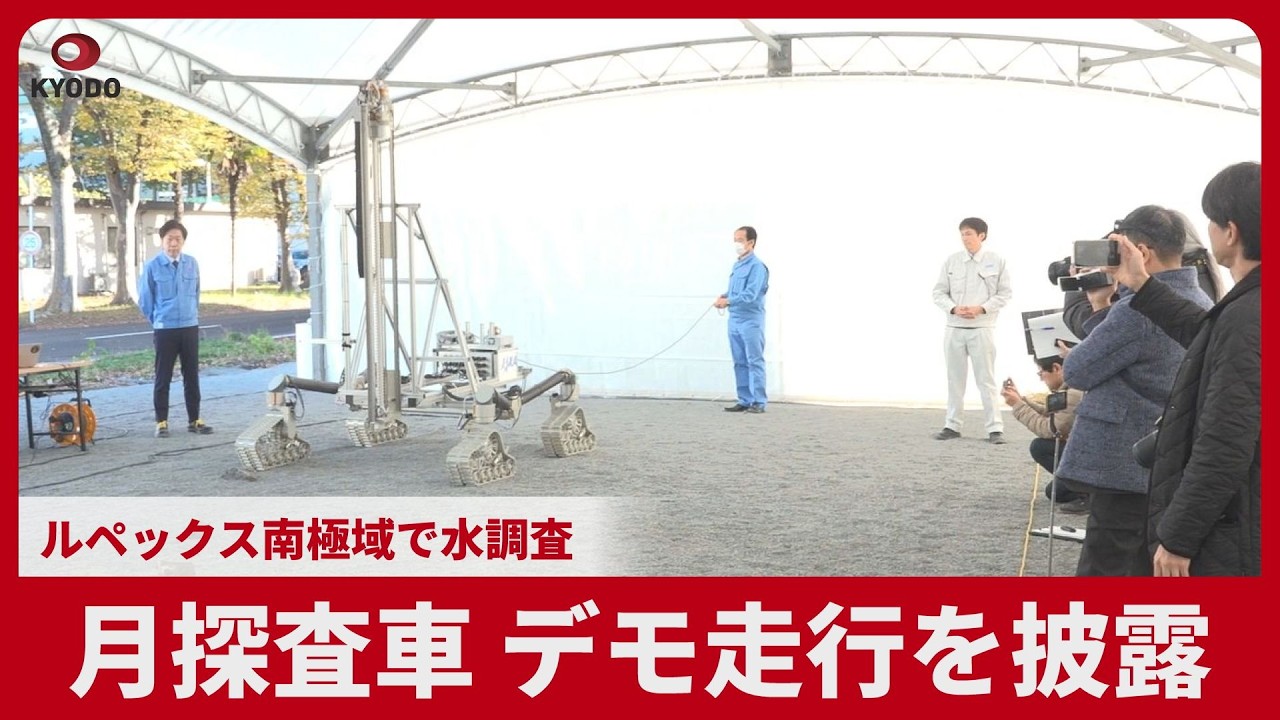
The Japan Aerospace Exploration Agency (JAXA) unveiled a driving demonstration of its lunar exploration rover on the Chofu Aerospace Center in Tokyo on November 25, forward of a deliberate mission to research water assets close to the moon’s south pole.
The Lunar Polar Exploration (LUPEX) mission, a joint venture between JAXA and the Indian Space Research Organisation (ISRO), goals to find out the amount and distribution of water within the lunar south polar area.
JAXA is concentrating on a launch aboard an H3 rocket in fiscal 2028, with the Japanese-developed rover mounted on a lunar lander developed by ISRO. The spacecraft will likely be housed contained in the rocket’s largest payload fairing.
Because the moon’s rotational axis is just barely tilted, the solar stays near the horizon in its polar areas, creating areas that obtain little or no direct daylight. These completely shadowed areas are believed to harbor water ice.
The mission goals to ship the rover into shadowed areas to research potential water deposits whereas sustaining communications with Earth.
Determining the provision of lunar water might assist assist future long-term exploration and human actions on the moon, with water doubtlessly serving as a supply of consuming water, oxygen and rocket propellant.
LUPEX represents the end result of greater than three many years of Japanese lunar exploration, marking a transition from orbital statement and experimental landings to the direct investigation of pure assets that would maintain human exercise past Earth.
The spacecraft is anticipated to weigh round six tons or extra at launch, with a payload of not less than 350 kilograms, together with the rover. JAXA goals to conduct exploration actions for greater than three months, protecting a number of areas with completely different geological and environmental traits.
JAXA SPACE EXPLORATION CENTER
Unlike earlier missions which have primarily relied on observations from lunar orbit, LUPEX will instantly study the soil beneath the moon’s floor. The rover will use scientific devices to determine promising deposits earlier than drilling a couple of meter underground to gather samples.
The samples will likely be heated inside an analytical chamber to launch water vapor and different unstable substances, permitting scientists to find out their chemical composition, water focus and attainable origins.
Seven scientific devices developed via worldwide cooperation involving Japan, India, the United States and the European Space Agency will assist the investigation.
These embrace a neutron spectrometer equipped by NASA to detect concentrations of hydrogen beneath the floor, ground-penetrating radar able to inspecting underground constructions, infrared devices to determine water and minerals, and gear to investigate the moon’s extraordinarily skinny environment.
月極域探査機(LUPEX)- 月の水を探し、人類の未来をひらく。| JAXA 有人宇宙技術部門+1
One of essentially the most distinctive options of the Japanese rover is its 4 impartial crawler models, designed to barter steep slopes and uneven terrain within the moon’s polar areas. A tower outfitted with photo voltaic panels will assist seize daylight arriving at low angles, whereas high-performance lithium-ion batteries and thermal insulation will assist operations underneath excessive situations.
The lunar south pole presents appreciable engineering challenges. Temperatures inside completely shadowed craters can fall beneath minus 200 levels Celsius, whereas the low angle of daylight creates lengthy shadows that complicate navigation and solar energy technology.
Communication with Earth will also be obstructed by surrounding mountains and crater partitions, requiring cautious planning of the rover’s exploration routes.
The presence of water on the moon has regularly reworked worldwide lunar exploration methods. For a lot of the twentieth century, the moon was broadly considered an virtually completely dry celestial physique.
Evidence obtained by subsequent spacecraft, together with India’s Chandrayaan-1 mission launched in October 2008, indicated that water and hydroxyl molecules have been current on the lunar floor. Later observations strengthened proof that water ice had accrued in completely shadowed areas close to the poles.
However, figuring out whether or not these deposits exist in concentrations enough for industrial or industrial use stays a significant scientific problem. LUPEX will search to determine whether or not water is current as ice combined with lunar soil, concentrated deposits or different kinds that would have an effect on the issue and price of extraction.
Water obtained regionally might considerably scale back the quantity of fabric that will must be transported from Earth. Separating water into hydrogen and oxygen might present gasoline for spacecraft, oxygen for astronauts and assets for future lunar settlements.
The improvement of such capabilities might ultimately permit the moon to function a staging level for missions deeper into the photo voltaic system, together with crewed expeditions to Mars.
Japan’s lunar exploration program dates again to January 1990, when the Institute of Space and Astronautical Science, a predecessor of JAXA, launched an experimental spacecraft named Hiten.
Weighing roughly 197 kilograms, Hiten was designed to show applied sciences for deep-space navigation and orbital management, together with the usage of lunar gravity to change a spacecraft’s trajectory and scale back gasoline consumption.
Hiten entered lunar orbit in February 1992, making Japan the third nation after the Soviet Union and the United States to position a spacecraft in orbit across the moon. Its mission ended with a managed affect on the lunar floor in April 1993.
Japan subsequently developed the LUNAR-A mission, an bold venture supposed to research the moon’s inner construction utilizing two devices embedded beneath its floor. The devices would have measured lunar seismic exercise and underground warmth move, however technical difficulties and extended improvement delays led to the venture’s cancellation in early 2007.
宇宙科学研究所+2
A serious breakthrough got here in September 2007 with the launch of Kaguya, also referred to as SELENE, aboard an H-IIA rocket from the Tanegashima Space Center in Kagoshima Prefecture.
Named after a princess from the normal Japanese folktale The Tale of the Bamboo Cutter, Kaguya was one of the vital complete lunar scientific missions because the United States’ Apollo program.
The spacecraft weighed roughly three tons and consisted of a most important orbiter working about 100 kilometers above the lunar floor and two smaller satellites supporting communications and gravitational measurements.
Kaguya collected intensive information on the moon’s mineral composition, geological formations, magnetic properties, gravitational area and topography, offering scientists with a extra detailed understanding of its formation and evolution.
The mission additionally achieved the primary direct measurements of the gravitational area on the far facet of the moon and captured high-definition photos of Earth rising above the lunar horizon.
Kaguya concluded its mission with a managed descent onto the lunar floor in June 2009, abandoning a considerable scientific database that continues to assist planetary analysis and exploration planning.
JAXA’s Planet Exploration+2
Japan’s efforts to succeed in the lunar floor have additionally encountered setbacks.
In November 2022, JAXA launched OMOTENASHI, an experimental miniature lunar spacecraft, aboard NASA’s Artemis I mission. The spacecraft was supposed to show a low-cost technique of reaching the lunar floor, however communication issues following its separation from the rocket prevented the deliberate touchdown operation.
Japan lastly achieved its first profitable mushy touchdown on the moon on January 20, 2024, when JAXA’s Smart Lander for Investigating Moon (SLIM) touched down close to Shioli crater.
The achievement made Japan the fifth nation to efficiently land a spacecraft on the moon, following the Soviet Union, the United States, China and India.
Nicknamed the “Moon Sniper,” SLIM was developed to show precision touchdown expertise utilizing onboard cameras, picture recognition and autonomous navigation.
Traditional lunar touchdown missions have usually required comparatively massive touchdown zones to accommodate uncertainties in navigation. SLIM was designed to land inside 100 meters of a predetermined goal, permitting future spacecraft to succeed in scientifically essential areas beforehand thought-about too troublesome to entry.
Despite experiencing an engine downside throughout its ultimate descent, SLIM landed roughly 55 meters from its supposed vacation spot, attaining its principal technological goal.
The spacecraft initially skilled difficulties producing electrical energy as a result of its photo voltaic panels have been going through the incorrect path, however operations resumed after the angle of daylight modified.
Although SLIM had not been designed to outlive the intense chilly of the lunar evening, it subsequently survived three lunar nights earlier than JAXA formally ended operations in August 2024.
DARTS at ISAS/JAXA+2
SLIM additionally deployed two miniature robotic automobiles, together with a baseball-sized remodeling robotic developed via cooperation involving JAXA, Japanese toy producer Tomy, Sony Group and Doshisha University.
The robotic captured a picture of the landed spacecraft, offering helpful details about its place and demonstrating the potential of compact robotic methods for future planetary exploration.
The applied sciences developed via SLIM are anticipated to assist subsequent Japanese missions by permitting spacecraft to land nearer to particular scientific targets and decreasing the gap that robotic automobiles should journey after reaching the floor.
LUPEX will construct on these achievements whereas increasing Japan’s capabilities in autonomous navigation, underground excavation, useful resource evaluation and long-duration operations on celestial our bodies.
The partnership with India additionally displays the rising significance of Asian international locations in worldwide house exploration. India achieved its first profitable lunar touchdown in August 2023 with Chandrayaan-3, which touched down within the moon’s southern excessive latitudes and deployed a small robotic rover.
Combining India’s lunar touchdown experience with Japan’s robotics, precision engineering and scientific instrumentation is meant to distribute improvement obligations and scale back the technological dangers related to more and more complicated missions.
JAXA’s lunar ambitions prolong past robotic exploration. Japan can also be collaborating within the United States-led Artemis program, which goals to determine a sustainable human presence on and across the moon.
Japan formally introduced its participation in this system in 2019 and has since pursued cooperation within the improvement of lunar transportation methods, habitation applied sciences, communications infrastructure and scientific gear.
One of Japan’s most vital contributions is a crewed pressurized lunar rover being developed by JAXA and Toyota Motor, popularly generally known as the Lunar Cruiser.
Unlike typical lunar automobiles that require astronauts to put on spacesuits all through their journeys, the Lunar Cruiser is meant to offer a pressurized dwelling and dealing surroundings, enabling astronauts to journey appreciable distances throughout the lunar floor.
The automobile is being developed with the purpose of supporting prolonged expeditions, with a cumulative touring vary exceeding 10,000 kilometers over its operational lifetime.
Engineers are investigating regenerative gasoline cell methods, autonomous driving applied sciences, superior suspension methods and power storage options able to working underneath the moon’s excessive environmental situations.
In April 2024, Japan and the United States signed an settlement underneath which Japan would offer the pressurized rover, whereas NASA would prepare its transportation to the moon and supply alternatives for 2 Japanese astronauts to take part in lunar floor missions.
JAXA SPACE EXPLORATION CENTER+2
Japan can also be contributing applied sciences to Gateway, an internationally developed house station supposed to function in lunar orbit and assist missions to the floor and doubtlessly deeper into house.
The renewed worldwide curiosity within the moon has more and more targeted on creating infrastructure quite than conducting remoted scientific expeditions. Future actions might embrace the development of everlasting analysis amenities, native power technology, useful resource extraction and the manufacturing of constructing supplies utilizing lunar soil.
Competition can also be intensifying as China pursues its personal lunar exploration program, together with plans for crewed landings and a long-term lunar analysis station, whereas non-public house firms are creating industrial lunar transportation companies.
For Japan, these developments current alternatives to use its industrial strengths in robotics, automotive engineering, electronics, superior supplies and precision manufacturing to an rising lunar economic system.
Nevertheless, vital uncertainties stay over the financial viability of lunar useful resource extraction. Mining water ice in extraordinarily chilly environments, processing massive portions of lunar soil and supplying enough power to industrial amenities would require applied sciences which have but to be demonstrated on a industrial scale.
LUPEX is meant to offer a number of the scientific and engineering information wanted to find out whether or not such ambitions are lifelike.
Source: Kyodo