


TOKYO –
A world race to develop sensible quantum computer systems is intensifying as IBM, Hitachi and different know-how firms compete to good completely different computing architectures, with researchers searching for to beat the big technical challenges of constructing machines able to fixing issues that may take as we speak’s strongest supercomputers 1000’s of years to finish.
Quantum computing is extensively thought to be one of the doubtlessly transformative applied sciences of the approaching many years. Unlike typical computer systems, which course of data utilizing binary digits representing both zero or one, quantum computer systems use quantum bits, or qubits, that may exploit quantum mechanical properties equivalent to superposition and entanglement to carry out sure forms of calculations in basically alternative ways.
The know-how might finally allow breakthroughs in drug discovery, supplies science, chemical simulations, industrial optimization and different fields the place typical computer systems battle with extraordinarily complicated calculations. For explicit issues, researchers envision quantum machines performing calculations in seconds that would in any other case require tens of 1000’s of years, though such dramatic benefits have but to be established for many sensible purposes.
Among the businesses pursuing the know-how are US-based IBM, one of many pioneers in growing commercially accessible quantum computing programs, Hitachi, which launched a full-scale quantum computing analysis and improvement undertaking in 2018, and TOPPAN Holdings, Japan’s largest printing group by home gross sales.
Researchers from Keio University, together with Professor Yamamoto, who has spent greater than 25 years finding out quantum know-how, are additionally concerned in inspecting the trade’s prospects and the technical obstacles that stay earlier than quantum computer systems might be extensively deployed.
One of the central questions dealing with the trade is which {hardware} structure will finally turn out to be the dominant commonplace.
Researchers are presently pursuing 5 main approaches, every providing completely different benefits and presenting distinct engineering challenges. Among the main contenders are superconducting quantum computer systems, developed by firms together with IBM and Google, and semiconductor-based programs being pursued by Hitachi.
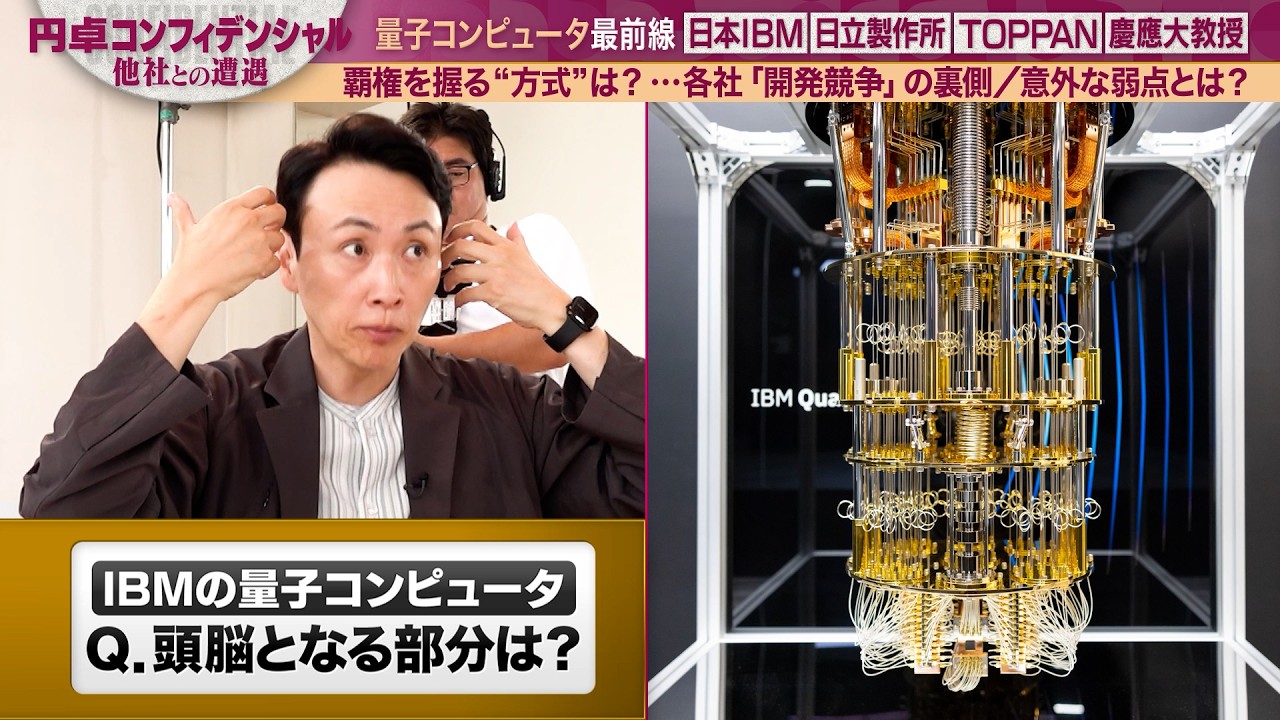
At the guts of IBM’s strategy is a quantum processor housed inside a fancy refrigeration system that resembles an elaborate metallic chandelier. Although the construction seems to be the machine’s central computing part, the precise quantum processor is a comparatively small chip positioned close to the underside of the meeting.
The surrounding equipment serves an important function: cooling the processor to temperatures approaching absolute zero, roughly minus 273 levels Celsius.
At such terribly low temperatures, superconducting circuits can function with just about no electrical resistance, serving to researchers create and management the fragile quantum states required for computation.
An IBM system mentioned in this system accommodates roughly 150 qubits, illustrating each the progress achieved in superconducting quantum computing and the persevering with issue of increasing these machines into programs containing vastly bigger numbers of dependable qubits.
Ordinary electrical conductors generate warmth when present passes by way of them due to resistance, inflicting some power to be misplaced. Certain supplies, nevertheless, turn out to be superconductors when cooled sufficiently, permitting electrical present to move with out resistance.
Superconducting quantum processors exploit this phenomenon to create circuits whose quantum states might be exactly manipulated utilizing electrical indicators.
The strategy has turn out to be one of the established applied sciences within the trade, with IBM, Google and Japanese firms together with Fujitsu conducting analysis into superconducting quantum computing.
However, superconductivity alone doesn’t remove the sources of errors that have an effect on quantum calculations. Qubits stay extraordinarily delicate to their environment, and even small disturbances brought on by warmth, vibrations or electromagnetic interference can disrupt the quantum data they include.
Protecting qubits from these disturbances, whereas concurrently controlling and connecting growing numbers of them, is without doubt one of the best obstacles to constructing sensible quantum computer systems.
Hitachi is pursuing a unique technique based mostly on semiconductor know-how, drawing on many years of expertise manufacturing superior digital circuits.
Its strategy entails fabricating microscopic constructions on silicon chips and trapping particular person electrons in fastidiously managed positions, with the quantum properties of these electrons serving as qubits.
The know-how’s principal benefit is the potential to rearrange qubits at extraordinarily excessive densities utilizing manufacturing strategies already established within the semiconductor trade.
Researchers describe the method as much like creating an egg carton on the microscopic degree. Electrical indicators produce a sequence of potential wells during which particular person electrons might be confined, permitting engineers to determine an array of quantum bits.
However, the obvious simplicity of arranging electrons conceals an immense engineering problem. Each electron have to be positioned and managed exactly, and even a small variety of lacking or incorrectly positioned electrons can compromise the operation of a quantum processor.
Hitachi finally goals to develop programs containing roughly a million qubits, a scale that researchers imagine would require exceptionally refined manufacturing and management applied sciences.
The firm has outlined intermediate objectives of reaching 100 qubits in 2028 and 1,000 qubits in 2030, reflecting a gradual strategy towards a lot bigger semiconductor quantum processors.
One of Hitachi’s most important developments considerations transferring particular person electrons between completely different positions on a chip.
Because quantum operations typically require interactions between qubits, researchers should be capable to convey electrons shut sufficient collectively to work together with out destroying their delicate quantum states.
Hitachi introduced a brand new management know-how in August aimed toward addressing this drawback.
The method entails transporting electrons throughout a semiconductor construction in a fastidiously managed method, very like transferring objects alongside a conveyor belt.
Rather than permitting electrons to journey by way of an uneven electrical potential, engineers create and alter a smoother pathway that permits the particles to maneuver between places.
Controlling the pace of this motion is especially essential.
If electrons journey too rapidly, stopping them at exactly the required place turns into troublesome, doubtlessly introducing errors into subsequent calculations.
Researchers defined that motion at speeds exceeding roughly 10 meters per second presents vital theoretical difficulties for correct management.
Although sooner transport would enhance the effectivity of quantum operations, growing pace additionally dangers introducing extra errors.
Hitachi’s improvement subsequently focuses on accelerating electrons, step by step slowing them and bringing them to a exact cease the place the required quantum interplay can happen.
The achievement represents progress towards making semiconductor quantum processors extra versatile, doubtlessly permitting qubits to work together with out requiring each electron to stay completely adjoining to the others.
However, researchers acknowledge that substantial enhancements will probably be wanted earlier than the strategy might be expanded to the dimensions required for commercially helpful quantum computer systems.
Another main problem is the big variety of electrical connections required to function a quantum pc containing tons of of 1000’s or tens of millions of qubits.
In typical semiconductor units, a lot of the digital management and sign processing takes place inside built-in circuits, minimizing the variety of exterior connections wanted.
Quantum computer systems, nevertheless, have historically relied on intensive wiring linking particular person qubits to exterior management programs.
As the variety of qubits will increase, the variety of required electrical connections can turn out to be unmanageable, creating issues involving bodily house, warmth, energy consumption and manufacturing complexity.
An IBM consultant raised the difficulty in the course of the dialogue, questioning how Hitachi supposed to regulate a processor containing a million qubits with out requiring an equally monumental community of exterior cables.
Hitachi’s proposed resolution entails stacking extra semiconductor chips on prime of the quantum processor, permitting extra of the management capabilities to be carried out throughout the machine itself.
By integrating a number of layers of circuitry, the corporate hopes to scale back the variety of connections extending outdoors the processor and create a extra compact computing system.
The strategy attracts on advances in three-dimensional semiconductor integration, an space the place the standard electronics trade has already made substantial progress.
Keeping extra management capabilities throughout the chip meeting might assist overcome one of many principal limitations to scaling quantum computer systems past as we speak’s experimental programs.
The dialogue additionally highlighted the significance of worldwide cooperation in quantum analysis, significantly between Japanese engineers and researchers based mostly within the United States.
IBM’s improvement actions contain scientists and engineers working throughout nationwide borders, whereas Japanese firms are searching for to mix their established strengths in semiconductor manufacturing, precision engineering and superior supplies with rising quantum applied sciences.
For Japan, the event of quantum computer systems provides a chance to determine a stronger place in a strategically essential trade that would affect future advances in computing, prescription drugs, manufacturing and nationwide safety.
Yet regardless of accelerating funding and vital technological progress, no single quantum computing structure has established a decisive benefit.
Superconducting programs profit from years of analysis and more and more refined processors, whereas semiconductor approaches supply the potential for larger qubit densities and better compatibility with present manufacturing infrastructure.
The final winner might rely much less on which know-how can display the most important variety of qubits within the laboratory than on which might function these qubits reliably, appropriate computational errors and scale economically to the tens of millions of bodily qubits doubtlessly required for complicated purposes.
As IBM, Hitachi and their rivals proceed refining their respective applied sciences, the race is transferring past demonstrations of quantum phenomena towards the way more demanding job of making reliable computing machines.
Whether superconducting circuits, semiconductor electron spins or one other quantum structure finally dominates stays unsure, however the engineering choices being made as we speak might decide which firms and nations lead the subsequent technology of computing.
Source: テレ東BIZ